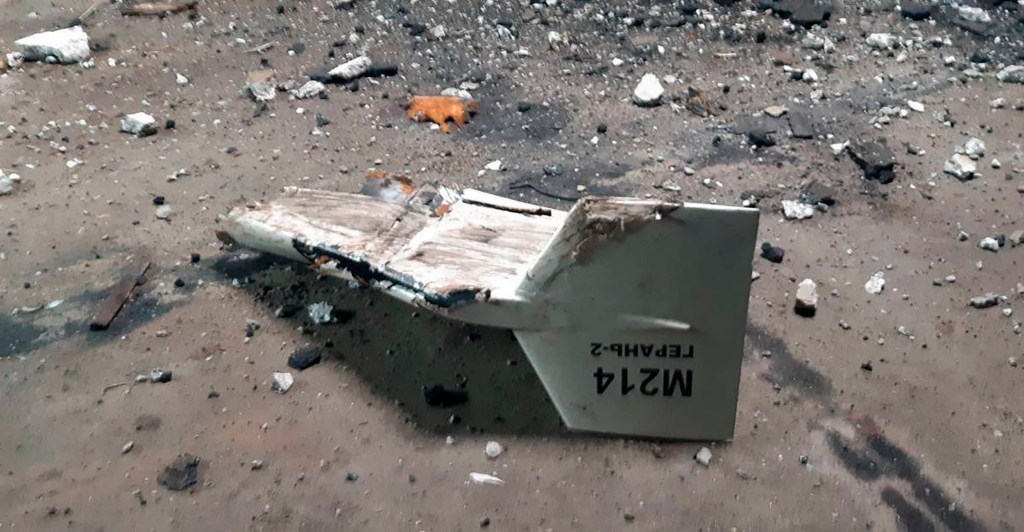
WASHINGTON ― The White House on Thursday accused Iran of sending military personnel to Crimea to assist Russian pilots who bombarded Kyiv with Iranian kamikaze drones earlier this week.
In a call with reporters, U.S. National Security Council spokesman John Kirby also warned that Russia, as it grapples with supply shortages, may seek advanced conventional weapons, including surface-to-surface missiles, after obtaining the Iranian-made Shahed drones.
Videos of delta-shaped Shahed drones conducting deadly strikes across Ukraine, including in Kyiv, have surfaced on social media in recent days. Refuting Russia and Iran’s denials, the White House said Iran has sent Russia dozens of such drones, as well as a small number of trainers and tech support personnel to assist Russian pilots in Crimea conducting the strikes.
“Iran and Russia can lie to the world, but they certainly can’t hide the facts, and the fact is that Tehran is now directly engaged on the ground,” Kirby said, adding that the U.S. would “pursue all means to expose, deter and confront Iran’s provision of these munitions against the Ukrainian people.”
Kirby said Iran brought in trainers after operator and system failures prevented the drones from striking their intended targets, adding that Russian operators are flying the drones.
Russia is believed to have sent waves of Shahed drones into Ukraine to strike power plants, residential buildings and other key infrastructure in Kyiv, the capital, as well as other cities. Ukraine’s Western-reinforced air defenses have made it difficult for Russian warplanes to operate, and killer drones are a cheap weapon to seek out and destroy targets while spreading fear among troops and civilians.
Pentagon Press Secretary Brig. Gen. Patrick Ryder echoed the White House assessment and told reporters Iranian officials are “lying” when they deny they provided Russia with the drones.
“We do assess that Iranians have been on the ground in Ukraine to assist Russia with the drone operations there,” Ryder said.
Asked whether Ukraine can strike the location where the drones are originating, Ryder said, “the Ukrainians have been pretty effective in terms of shooting a lot of those drones down.” He added that the Pentagon’s focus continues to be providing Ukraine with military aid while the administration responds on economic and diplomatic tracks.
Ukraine on Tuesday accused Iran of violating a U.N. Security Council ban on the transfer of drones capable of flying 300 kilometers and invited U.N. experts to inspect what it said were Iranian-made drones being used by Russia against civilian targets.
The U.N.’s most powerful body in 2015 adopted Resolution 2231 to endorse the nuclear deal between Iran and six key nations — the U.S., Russia, China, Britain, France and Germany, aimed at curbing Tehran’s nuclear activities and preventing the country from developing a nuclear weapon.
Kirby said the resolution would allow the U.S. to continue to sanction Iranian entities involved in developing and manufacturing drones. He also said the U.S. would “vigorously enforce U.S. sanctions on both the Russian and Iranian arms trade.”
“We’re going to make it harder for Iran to sell these weapons to Russia,” he said.
The comments come as the U.S. is working with allies to fulfill Ukraine’s requests for air defenses. When Defense Secretary Lloyd Austin and Joint Chiefs Chairman Gen. Mark Milley were in Brussels earlier this month to coordinate military aid to Ukraine, they said they were organizing a patchwork of systems to provide Ukraine with layered defenses.
“I can’t tell you today what that’s going to look like [or when] we’re going to be able to move additional air defense capabilities to to Ukraine, but I can assure you that DoD is well aware of the threat and is working hard to see what they can do to to help the Ukrainians deal with the threat,” Kirby said.
The Pentagon has committed to providing Ukraine with counter-drone systems, including the Vampire truck-mounted rocket launcher from L3Harris Technologies, and pledged to provide the National Advanced Surface-to-Air Missile System, or NASAMS. Other countries too have provided air defenses; Slovakia sent Ukraine its S-300 and Ukraine recently deployed an IRIS-T system from Germany.
With reporting by The Associated Press