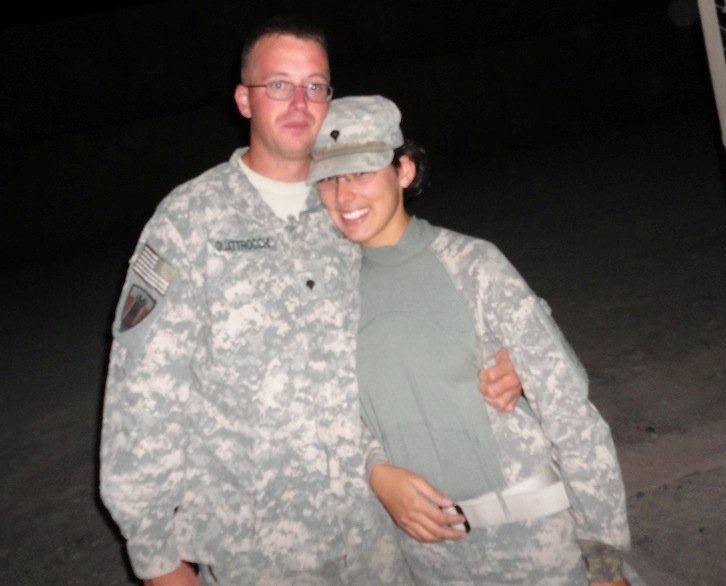
Army National Guard Spc. Robert Quattrocchi, 31, spends much of his time these days helping wife Monica care for the couple’s 4-month-old daughter in a rambling, uninsulated Georgia farmhouse that belongs to his in-laws.
It wasn’t supposed to be like this. Just over a year ago, the Quattrocchis owned a four-bedroom home in Cumming, Georgia, and Robert had plans to deploy with the 278th Military Police Company.
But during pre-mobilization training in early 2013, Quattrocchi aggravated an injury he received in 2011 while serving in Afghanistan. He was placed, he said, in a “dead man’s profile” — barred from deploying or doing meaningful work with the company’s rear party.
When he was told to go home to recover, he was assured he’d receive incapacitation pay shortly thereafter.
But it’s been 18 months. And in the meantime, he’s lost his home and a car and is relying on his wife’s parents to feed his family.
“It’s been awful watching all this happen. It’s not just our life. My parents lives’ have been impacted and my daughter’s. We’ve exhausted every avenue of approach and have come up empty-handed,” Monica Quattrocchi, 23, said during an interview Aug. 27.
Robert Quattrocchi’s financial and Guard career troubles began unknowingly when he left Fort Dix, New Jersey, after demobilizing in 2011.
The paperwork declaring that his original back injury had occurred in the line of duty was never filed.
And the process for receiving incapacitation pay hangs largely on the outcome of the investigation into whether an injury occurred during military duty.
Quattrocchi should have received another line-of-duty affirmation for his back when he reinjured it during the pre-mob workups. But investigations into his injuries appear to be ongoing.
The horizontal construction engineer has been able to receive medical treatment from the Veterans Affairs Department.
But he has had trouble landing a job in his original civilian profession — construction — or any other line of work for which he is qualified, mainly manual labor.
Monica,who recently gave birth to daughter Elizabeth, was in the National Guard as well and served alongside her future husband in Afghanistan. But she had to leave service because the couple couldn’t afford the gas needed for Monica to get to drill.
Quattrocchi hasn’t filed for a medical evaluation board because it never occurred to him to do so. He always thought he’d recover and continue serving.
“I am really good at being a soldier. I take pride in it, too. If anything, I wanted to do it full time, not get out,” he said.
His contract is up in November and he wasn’t sure whether the National Guard could release him while he is in a “holding pattern.”
But now he’s worried.
“I’m not getting any feedback except that it’s time to turn in my issued stuff. … I keep waiting to hear back from them. But I feel like they’re going to, for lack of a better word, screw us over — basically find loopholes, a way out of being responsible,” Quattrocchi said.
When Quattrocchi first was injured, he was treated by unit docs with pain medication and anti-inflammatories, mainly ibuprofen and tramadol. He later was diagnosed with degenerative discs and and pinched nerves in his lumbar region and has received cortisone shots to treat the problems.
At the VA, he is under a physician’s care, participating in physical therapy and receiving prolotherapy, a treatment designed to strengthen weak tendons and connective tissue.
He calls his unit every week and has asked multiple times that officials release his medical records to the VA. It hasn’t happened. And the unit cannot tell him where his INCAP application is.
The brigade referred questions from Military Times to the Georgia National Guard. A spokeswoman said she could not comment on the particulars of the Quattrocchi case, citing privacy laws, but said “it is the policy of the Defense Department to provide medical care to reserve component members for any injury or illness incurred or aggravated in the line of duty.”
“In keeping with this policy, an injury reported to the chain of command prompts an initial line-of-duty report to ensure that service members can seek initial medical care without incurring out-of-pocket expenses,” spokeswoman Ashlie Shrewsbury said.
But the medical care is not the issue; Robert Quattrocchi said the care he is receiving at VA is good.
The problem is not having any money. And being unable to get a job. And relying on the kindness of family, which includes sharing a roof with the parents in a home that has no air conditioning, no insulation and no heat.
“There’s a fireplace in the living room but no heat in any of the other rooms. That’s OK when it was just us. But I’m not sure what we’re going to do this winter. We have those oil-filled radiators, but they are expensive to run,” Monica Quattrocchi said.
The couple hope the situation gets ironed out soon. She is taking online college courses so she can improve her employment prospects, and Robert Quattrocchi is wondering what his next steps will be.
They likely include college — paid for by the Post-9/11 GI Bill — to study engineering.
In the meantime, though, Quattrocchi is contemplating starting the medical evaluation board process, albeit reluctantly.
“We have exhausted every avenue of approach that we have and come up empty-handed. I want everyone who is in this position to be aware of the possibility that they might not get any help from the military,” he said.