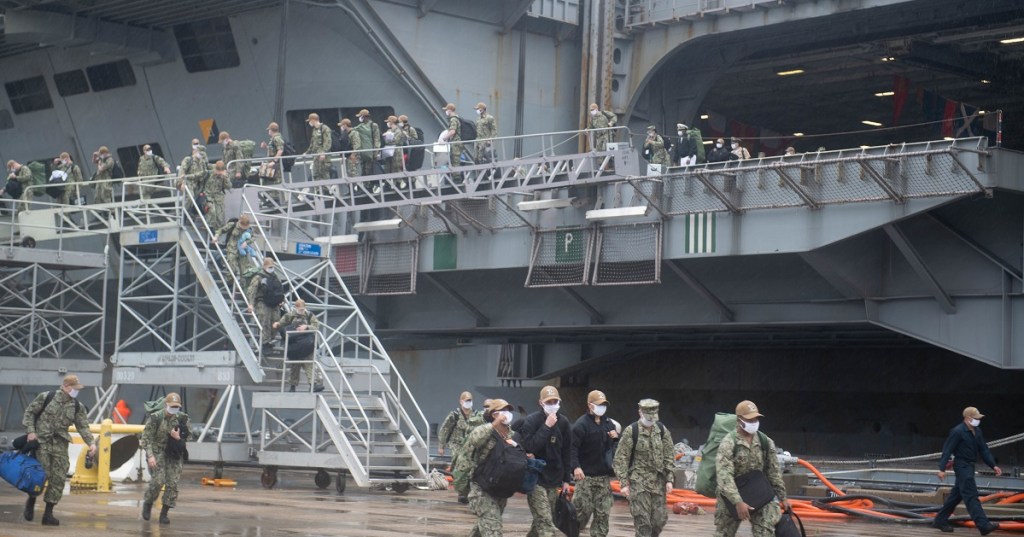
In a year that’s been taxing for everyone across the military, Big Navy is trying to add a bit of extra cash to sailors’ pockets to mitigate the pain and inconvenience of longer deployments with no port calls that have come to mark the COVID-19 era.
Family Separation Allowance, FSA, is a benefit that generally kicks in after sailors have been underway for 30 days, and can amount to an extra $250 a month, according to the U.S. Department of Defense.
But these days, with sailors entering a quarantine period of 14 to 21 days before they deploy with their ship, submarine, squadron or other unit in order to create a COVID-free bubble, leaders are working to change the law so that FSA kicks in once sailors enter the restriction of movement, or ROM, period, Chief of Naval Personnel Vice Adm. John Nowell said this week.
As leadership works with the Pentagon and lawmakers to change FSA, Nowell acknowledged such a change isn’t a cure-all for stressed sailors.
“When we start talking about stress, that’s not a single-point solution,” he said Tuesday. “But, you know, a little extra money in the pocket does help.”
Current statutes prohibit such a change, so the Navy has worked to get a provision inserted in the 2021 defense authorization bill that will allow FSA to go into effect when sailors start their ROM, according to Nowell’s spokesman, Cmdr. Dave Hecht.
The version of the defense policy bill passed by the U.S. House of Representatives already includes that provision, but differences between the House and Senate versions of the legislation must still be worked out in conference, and that is not expected to be voted upon until after the election.
“We are continually mindful of feedback from Sailors and their families when making decisions on these types of matters,” Hecht said in an emailed statement. “Permitting the 30-day clock to start at the beginning of a pre-deployment quarantine would provide some financial relief to support Sailors and their families during these challenging times.”
At a reporters’ roundtable earlier this month, Nowell said the attempted policy change reflects the fact that leaders know this year has been hard on sailors and their families.
“We’re listening,” he said. “We’re taking action.”
Attempts to create and maintain COVID-free bubbles has helped the fleet avoid the type of widespread outbreaks seen this spring on the aircraft carrier Theodore Roosevelt and the guided-missile destroyer Kidd, officials said at that roundtable.
But Vice Adm. Phillip Sawyer, deputy chief of naval operations for operations, plans and strategy, acknowledged on the call that these policies aren’t easy.
“Getting COVID-free and staying COVID-free is a challenge and it comes at a cost,” he said. “We know these mitigations are hard on our sailors and their families.
“But it’s a critical piece of protecting our sailors who have signed up to serve,” Sawyer added. “All of this is about keeping our sailors safe.”