Whether they’re training wounded warriors for high-paying jobs in cybersecurity or giving recycled, sanitized medical equipment to veterans and family members, this year’s Newman’s Own award winners are focused on meeting specific needs in the military and veteran communities.
The winners were honored in a ceremony Thursday at the Pentagon Hall of Heroes. They received a combined total of $200,000 to expand their work.
“Every aspect of military life is touched by this year’s award recipients today,” said Marine Corps Gen. Joe Dunford, chairman of the Joint Chiefs of Staff. “On behalf of all those who wear the uniform today and their families, I want to thank you and the organizations you represent for the impact you’ve had on military families.”
The top winner is Give An Hour, a volunteer organization that connects service members, post-9/11 veterans and their families with volunteer mental health professionals willing to donate their direct counseling services. The vast majority of people who seek help from the organization go through its website GiveAnHour.org to find a provider. “As we grow and expand, it creates demands on the technology,” said Dr. Barbara Van Dahlen, a psychologist in the Washington, D.C., are who founded the nonprofit.
The $50,000 Newman’s Own award will help upgrade technology, she said.
The volunteers provide confidential care that’s outside the military community, an option for some troops and families who may not seek care otherwise.
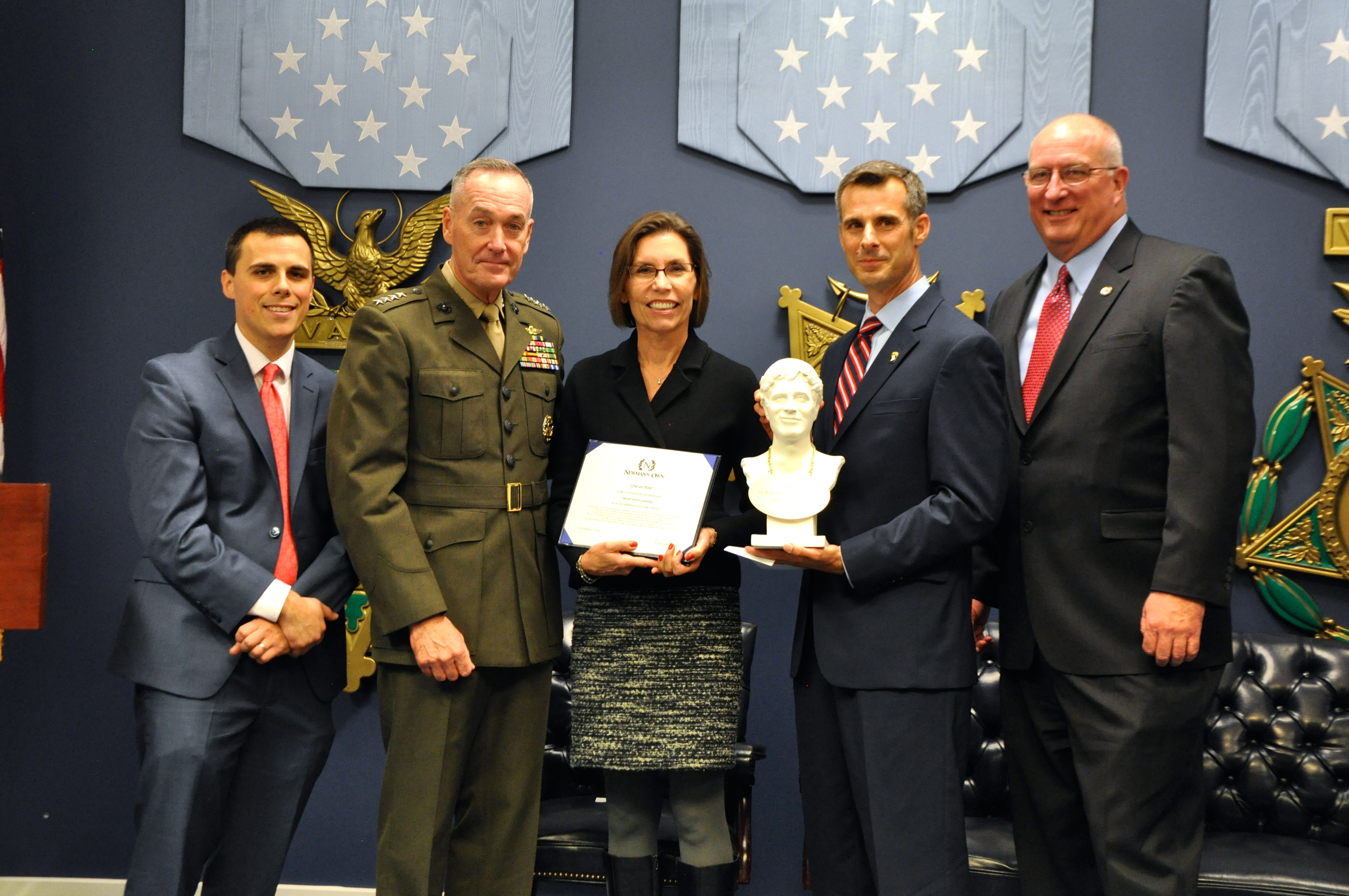
Barbara Van Dahlen, a Newman’s Own award winner, center, with, from left: Tony Lombardo, Military Times Executive Editor; Gen. Joe Dunford; Jeffrey Smith, Newman’s Own VP of Operations; and David Coker, Fisher House Foundation President
Photo Credit: Ashley Estill, Fisher House Foundation.
Since establishing the awards in 1999, Newman’s Own has recognized 169 programs with grants totaling more than $1.5 million. Judges evaluate entries based on their impact on their respective communities, as well as creativity and innovation. This year, more than 300 entries were received.
“The organizations we’ve supported through this program and the lives we’ve been able to touch through you is the real payoff,” said David Coker, president of the Fisher House Foundation, which, along with Newman’s Own and Military Times, sponsors the award.
Dunford said the event “reinforces initiatives that have shown great promise. It does identify organizations that are truly making a difference and allows them to make a greater difference.”
Military Times Executive Editor Tony Lombardo praised the organizations for finding unique ways to address real problems.
“You are positively affecting service members’ lives and in some cases putting them on an entirely new path — one toward confidence, stability and renewal.”
In receiving the award, Barbara Van Dahlen said she was honored to be among those receiving recognition and noted that none of the organizations can do their work alone. “We’re all part of a network that must work together,” she said.
She remembers when Paul Newman created Newman’s Own, with its brand of salad dressings and other items, she said. “I remember thinking what an amazing idea that someone of that stature would create a company to give all those proceeds to organizations that are doing good.
“Never did I imagine I’d be standing here today to receive some of those wonderful funds.”
The winning programs this year have been launched within the last decade, but have made an impact.
Since Give an Hour was launched 10 years ago, professionals have donated at least 200,000 hours of free care, worth more than $20 million, said Van Dahlen. The actual amount of assistance is probably much higher, she said, because many of the mental health professionals don’t report back how many hours they’ve donated.
“When I started Give An Hour, mental health was not something people in this community wanted to talk about. I felt like an unwanted stepchild,” Van Dahlen said. “But as time has passed, it makes me proud, and I’m encouraged to see that we work closely with DoD, the VFW, and nonprofits. People understand the importance of emotional well being.”
This award shows that the issue is becoming more recognized, and that people are becoming more comfortable addressing it, she said.
The organizations that will each receive $37,500 include:
Military Spouse JD Network Foundation, which is the charitable arm of the network that supports military spouse attorneys in their efforts to maintain a career during military moves. The foundation also houses the Justice for Military Families pro bono program that connects Gold Star Families who need legal assistance to military spouse attorneys willing to donate their services.
The award money will help MSJDN grow both programs, said Josie Beets, president of the Military Spouse JD Network. Since 2011, when MSJDN began its efforts working with the states to overcome licensure roadblocks for military spouse attorneys, 20 states have adopted measures addressing the issue. On Oct. 1, North Dakota will become the 21st state, as the state’s supreme court’s rule becomes effective that day.
MSJDN will be able to redouble efforts in other states, and will also focus on going back to states where rules have been adopted, to ensure those rules are working for military spouse attorneys.
In their legal assistance for Gold Star families, MSJDN has found that sometimes family members just need legal advice, perhaps not legal representation. Because the network gets a lot of repeat requests about topics such as handling a son’s or daughter’s estate, MSJDN will create some information papers on these topics. “We want to demystify the legal process,” she said.
“We’re an all-volunteer organization, but even a small amount of money makes a difference,” Beets said. “What we’ve done so far is from passion. With passion and resources, you can’t lose.”
Dryhootch Peer Support Program, a nonprofit peer support program that operates three locations in Wisconsin and one in Chicago, offers veterans a safe, comfortable environment to gather informally. Dryhootch was founded in 2008 by Bob Curry, a Vietnam veteran who experienced the effects of post-traumatic stress, and the healing power of his veteran buddies who helped him through rough times.
“I knew we need to help these people come home and not deal with it the way we did,” said Curry, who suffered from alcoholism and other issues as he repressed his emotions. “Dryhootch” comes from the military term “hootch,” for a hut or place to sleep during combat. They’ve added “dry” to emphasize an environment free of alcohol and drugs.
Their core is the veteran peer support specialists they employ, offering free support for veterans and families, said Leah Lockett, director of development for the organization that offers coffee shop-type environments with sofas for hanging out and rooms for meetings and activities, and are located near VA medical centers.
Dryhootch also offers activities that bring together veterans and their families. The money from the Newman’s Own award will help expand these activities and reduce the cost for veterans and families. The various locations offer a variety of programs, ranging from “family art platoons” with a variety of hands-on projects, to father-son fishing trips, to Valentine’s Day caregiver wellness retreats. On Valentine’s Day, women were treated to a wellness retreat, with donations from a local spa, but the women still had to pay $30 each. Lockett said she hopes next year, it will be free, with the help of this donation.
Project MEND‘s veteran program provides recycled medical equipment such as wheelchairs, and assistive technology, to veterans in Texas and their family members. It’s a part of a larger program for those who are disabled, to get people the right equipment at the right time to help them be mobile, independent and to generally improve their lives. Veterans don’t have to have a service-connected disability or a VA disability rating in order to receive help.
About one-third of the population the group serves are veterans or family members, said Denise Bennett, development director. In 2015, the program helped 447 veterans or dependents, but the needs are not completely met, she said. On the average, Project MEND turns away at least two veterans a day because it doesn’t have the resources. “And that breaks our heart,” she said. “This Newman’s Own award couldn’t have come at a more perfect time,” she added, because funding has dried up from some corporate sponsors.
“Our ability to serve veterans is only limited by the availability of resources. There is no shortage of veterans. Even if they are served by the VA, there’s a long list of things that are not covered.”
Project MEND accepts donations of lightly used wheelchairs and hospital beds and other equipment; and disassembles them, sanitizes them and puts them back into service. The nonprofit is licensed by Texas to salvage this type of equipment and meets high standards regarding sanitization and other requirements. “Nobody else in Texas does what we do,” said Cathy Valdez, executive director.
When funding is available, Project MEND also provides assistive technology. For example, it provided an iPad for Donna Lowery, a veteran’s wife who lost her arms and her legs as a result of complications from sepsis. The iPad helps her communicate with others by using a dictation program that translates into text what she’s saying.
Last year, the organization spent $77,000 on assistive technology for veterans and family members.
“We hope this will raise national awareness so it can be duplicated across the country,” Bennett said. “I can’t tell you how many calls we get from people in other states asking how they can get this assistance.”
Wounded Warrior Cyber Combat Academy retrains wounded warriors to move from the physical battlefield to the cyber battlefield, said Jim Wiggins, founder and executive director of the FITSI Foundation, which operates the program.
Troops who have gone through this training are pulling in salaries of $70,000 to $100,000 annually, working for the government, contractors and others in the private sector. The troops take the eight-month course online, at night. The studies start from ground zero, teaching how a computer works and moving to other areas such as offensive and defensive security operations and ethical hacking. By the end of the course, the students have six different certifications.
Each class is free to the wounded warrior. The academy provides about $4,000 per student for textbooks, examination fees, instructor fees, and other costs. The program is paid for by grants and from private-sector funding.
“With their military backgrounds, with these certifications, they tend to be very appealing to employers,” said Wiggins, who is a cyber instructor who has applied his knowledge to philanthropy. He’s an instructor for the program, but donates his time.
“It’s really fun to see the impact. With the jobs they’re getting, they continue to serve their country.”
Karen Jowers covers military families, quality of life and consumer issues for Military Times. She can be reached at kjowe